

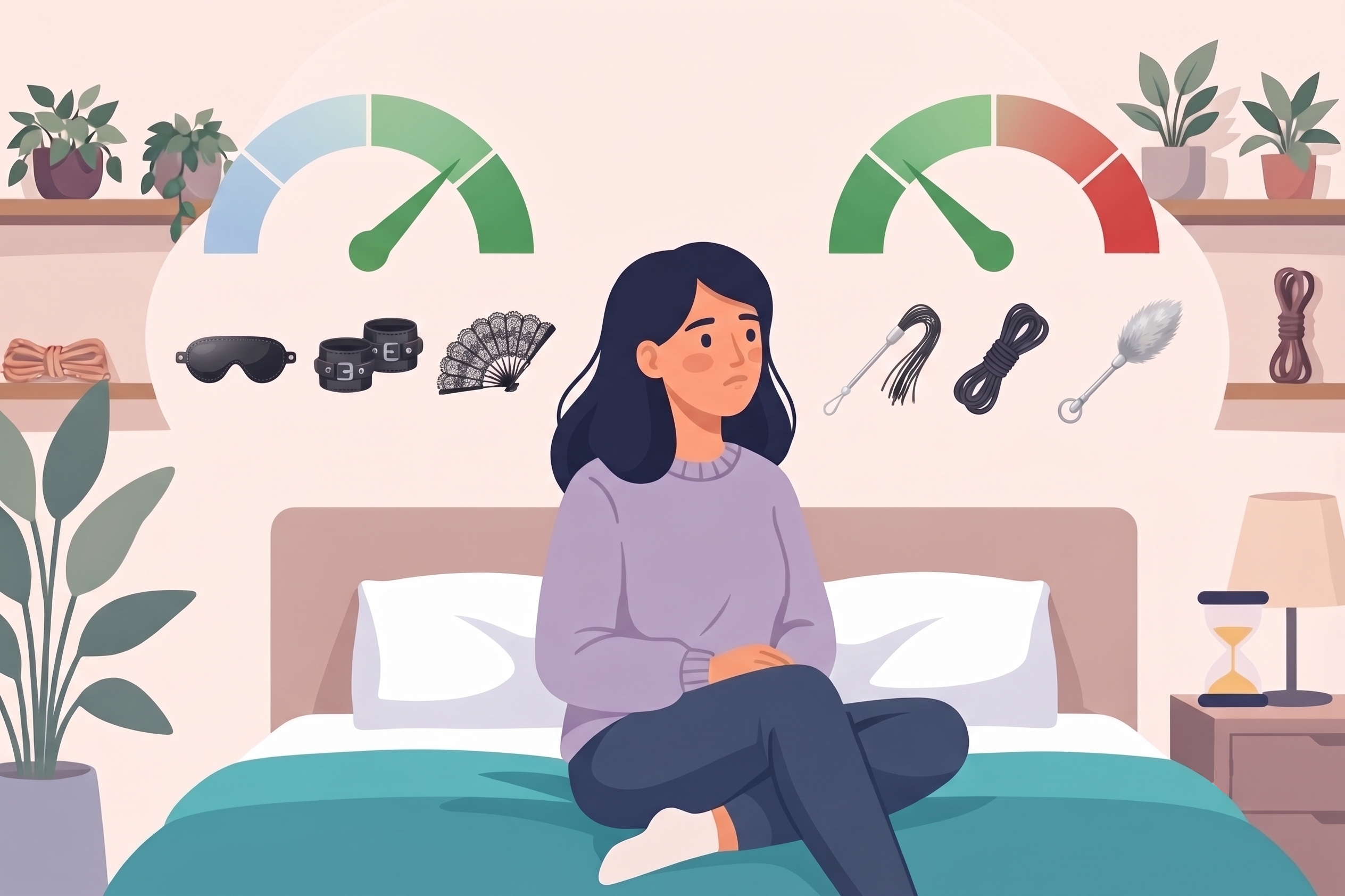
How Common Is BDSM? Fantasy, Practice, Pleasure and Risk
TL;DR
- BDSM is more common in fantasy than in regular practice. Across multiple studies, 40–70% of people reported BDSM-related fantasies, while approximately 20% reported having participated in BDSM-related activities.
- The estimate varies according to what researchers measure. In one representative Belgian study, 46.8% had tried at least one BDSM-related activity, but only 12.5% participated regularly and 7.6% identified as BDSM practitioners. Attendance at BDSM clubs or events appears to be much less common, at approximately 1%.
- BDSM is not only about pain. Practitioners described enjoyment, sexual arousal, stress relief, emotional release, novelty, role exploration and connection as reasons for participating.
- Popularity should never be mistaken for safety. Risk varies greatly by activity, intensity, preparation, health factors and environment. Consent, clear boundaries, active check-ins, nonverbal signals, sober decision-making and appropriate aftercare remain important—even when a safeword has been established.
For some people, BDSM is a visible subculture; for others, it is a private interest or a fantasy they never intend to act on. That makes the apparently simple question—“How common is BDSM?”—difficult to answer.
In previous Velora articles, I have explored what BDSM is and why people may be drawn to it, how to talk about kinks without fear of judgment, and how consent and preparation can support healthier exploration.
Velora has also created practical resources, including our BDSM Healthy Practice Checklist, BDSM Framework and Yes, No, Maybe List.
This article takes a different approach. Instead of providing another general introduction, it examines what the research tells us about BDSM fantasies, activities, identity, pleasure and risk—and why studies produce such dramatically different statistics.
There Is No Single BDSM Prevalence Number
When chatting with Velora’s customers, I sometimes hear from people who enjoy being blindfolded or spanked but do not identify as BDSM practitioners.
That distinction helps explain why answers to the question “How common is BDSM?” vary so widely.
What Population Studies Have Found
| What researchers measured | Finding | Study and context |
| BDSM-related fantasies across multiple studies | BDSM-related fantasies were reported by 40–70% of people across genders, while about 20% reported engaging in BDSM. | A 2020 systematic scoping review found this range across studies using different definitions and samples. It is not one universal estimate. |
| Fantasies about being sexually dominated | 64.6% of women; 53.3% of men | Joyal, Cossette and Lapierre, 2015, involving 1,516 Québec adults. Fantasy does not necessarily indicate a desire to enact it. |
| Fantasies about sexually dominating someone | 46.7% of women; 59.6% of men | The same Québec study measured specific fantasies rather than BDSM identity. |
| At least one lifetime BDSM-related experience | 46.8% | Holvoet et al., 2017, a representative Belgian sample of 1,027 adults. Trying one listed activity is not regular practice. |
| Interested in BDSM | 26% were interested, and 7.6% self-identified as BDSM practitioners | The same Belgian study found interest more common than identity. |
| Regular participation in at least one activity | 12.5% | The same study found regular practice much less common than lifetime experimentation. |
| Attendance at BDSM clubs or events | Approximately 1% | A 2019 review found public participation much less common than private interest. |
| Lifetime experience with specific activities | About 30% spanking, 20% tying or being tied and 13% playful whipping | A representative US survey of 2,021 adults asked about behaviours, not BDSM identity. |
| BDSM participation during the previous year | 1.8% | A representative 2008 Australian telephone survey of 19,307 adults used one broad question about “B&D or S&M.” |
What can we learn from these findings? A clear pattern emerges.
Fantasy → interest → experimentation → regular practice → BDSM identity → public participation
The percentage generally falls as the definition becomes narrower or requires frequent, identity-based or public involvement. It would therefore be misleading to say either “almost half of people practise BDSM” or “only 1.8% are interested.” Each statement removes the conditions that give the percentage meaning.
Why Do the Findings Differ?
Several factors help explain the differences among the findings cited above. One is terminology: a question about blindfolding may receive more positive responses than one using “BDSM” or “S&M.” Timeframe also matters; lifetime experience generally produces higher figures than activity during the previous year.
Interest Is Not Limited to One Region
Velora receives BDSM-related questions and product inquiries from people in many countries, including China, Mongolia and Nepal. This customer observation is not population research, but it challenges the assumption that BDSM curiosity exists only in Western cities with visible kink communities.
Among the questions we receive, many concern blindfolds, soft cuffs, texture play and beginner impact tools. Fewer questions concern suspension, electrical play, neck compression or other higher-risk activities. These higher-risk activities should not be treated as natural “next steps” simply because someone has tried a blindfold or restraint.
What Do People Find Pleasurable?
A 2023 international survey asked 810 BDSM practitioners why they participated. Respondents could give more than one answer. Enjoyment or fun was mentioned most often, by 45.3%. Sex, arousal or satisfaction appeared in 24% of responses; mental-health-related reasons, including stress relief and catharsis, in 18.8%; and connection with others in 14.9%.
This self-selected sample of practitioners is not representative of everyone and cannot prove that BDSM produces health benefits. It does show that participants’ motivations extend beyond pain and may include play, eroticism, novelty, emotional release, role exploration and connection.
A Velora Customer’s First Exploration
A returning Velora customer had previously purchased a discreet pleasure product. As her relationship became more established and trust grew, she became curious about exploring a blindfold and light impact play. Her first concern was not which product to choose, but how to begin the conversation.
She followed suggestions from Velora’s guide, How to Talk About Kinks Without Fear of Judgment. On a relaxed day, she sat face-to-face with her partner and explained what interested her, which boundaries she wanted respected and which precautions she thought they should take.
The couple later incorporated Velora’s Blindfold Kit and Leather Pony Tail into their exploration. They first used the tail gently for external texture play and light impact before wearing the plug as intended. They established a safeword and nonverbal signal, checked in throughout, cleaned the product before insertion, used lubricant and discussed the experience afterward.
She later told us that the experience—and the communication surrounding it—left them feeling closer.
Her story does not establish how BDSM affects relationships generally. It illustrates what prevalence figures cannot capture: being curious about BDSM, identifying as a practitioner and choosing to share a particular experience with a partner are separate steps.
What Do We Know About Injury?
In a 2021 survey of 1,398 kink-involved or kink-identified adults, 13.5% reported a kink-related injury. Because participants came from a kink-involved population, this is not the injury rate for everyone who experiments with BDSM.
The reported injuries varied considerably: a consensual mark is not medically equivalent to nerve damage, a fall or a neck injury.
A forensic review identified 17 published BDSM-related deaths. Fifteen involved strangulation, while drugs or alcohol were present in 64.3% of cases.
These selected cases cannot establish the likelihood of death. They do, however, show why neck compression, impaired communication and substance use should not be grouped casually with lower-complexity activities.
Lower-complexity activities are not risk-free. At one BDSM event Velora attended, someone described how his blindfolded partner misjudged a bed’s edge and fell. Another attendee explained that flogging could leave marks, requiring agreement about where impact could land and whether marks were acceptable.
A safeword is not failsafe: it may be missed or misunderstood. Clear consent, a nonverbal signal, active observation and check-ins remain necessary.
What Can We Reasonably Conclude?
As we reviewed the research at Velora, one thing became clear: there is no single number that can tell us how many people “do BDSM.” BDSM-related fantasies and occasional activities appear to be relatively common, while regular practice, public participation and identification with the BDSM community are less common. To us, this is an important reminder that curiosity about BDSM is neither rare nor something to feel ashamed of.
But popularity does not automatically mean safety. The risks depend on the activity, its intensity, the setting, the preparation involved, each person’s health and the trust and communication between partners. At Velora, we believe curiosity should be met with honest information—not judgment, pressure or false reassurance.
In our next article, we will take a closer look at common BDSM tools, different types of play and the specific safety considerations that come with each, so you can explore with greater knowledge, confidence and care.
Sources
- Brown, A., Barker, E. D., and Rahman, Q. (2020). “A Systematic Scoping Review of the Prevalence, Etiological, Psychological, and Interpersonal Factors Associated With BDSM.” The Journal of Sex Research, 57(6), 781–811.
- Joyal, C. C., Cossette, A., and Lapierre, V. (2015). “What Exactly Is an Unusual Sexual Fantasy?” The Journal of Sexual Medicine, 12(2), 328–340.
- Holvoet, L., Huys, W., Coppens, V., Seeuws, J., Goethals, K., and Morrens, M. (2017). “Fifty Shades of Belgian Gray: The Prevalence of BDSM-Related Fantasies and Activities in the General Population.” The Journal of Sexual Medicine, 14(9), 1152–1159.
- De Neef, N., Coppens, V., Huys, W., and Morrens, M. (2019). “Bondage-Discipline, Dominance-Submission and Sadomasochism (BDSM) From an Integrative Biopsychosocial Perspective: A Systematic Review.” Sexual Medicine, 7(2), 129–144.
- Herbenick, D., Bowling, J., Fu, T. C., Dodge, B., Guerra-Reyes, L., and Sanders, S. (2017). “Sexual Diversity in the United States: Results From a Nationally Representative Probability Sample of Adult Women and Men.” PLOS ONE, 12(7), e0181198.
- Richters, J., de Visser, R. O., Rissel, C. E., Grulich, A. E., and Smith, A. M. A. (2008). “Demographic and Psychosocial Features of Participants in Bondage and Discipline, ‘Sadomasochism’ or Dominance and Submission (BDSM): Data From a National Survey.” The Journal of Sexual Medicine, 5(7), 1660–1668.
- Westlake, B., and Mahan, I. (2023). “An International Survey of BDSM Practitioner Demographics: The Evolution of Purpose for, Participation in, and Engagement With, Kink Activities.” The Journal of Sex Research.
- Sprott, R. A., Randall, A., Smith, K., and Woo, L. (2021). “Rates of Injury and Healthcare Utilization for Kink-Identified Patients.” The Journal of Sexual Medicine, 18(10), 1721–1734.
- Schori, A., Jackowski, C., and Schön, C. A. (2022). “How Safe Is BDSM? A Literature Review on Fatal Outcome in BDSM Play.” International Journal of Legal Medicine, 136, 287–295.
Frequently Asked Questions
How common is BDSM?
There is no single percentage that answers this question. BDSM-related fantasies and occasional experimentation appear relatively common, while regular practice, BDSM identity and participation in public kink communities are progressively less common. Any statistic should therefore be read together with what the study measured, whom it surveyed and the timeframe it used.
Does having a BDSM fantasy mean someone wants to try it?
No. A fantasy can be interesting or arousing without being something a person wants to experience in real life. For example, one study found that 64.6% of women and 53.3% of men had fantasized about being sexually dominated, but fantasy alone does not establish an intention to act on it.
Why do BDSM prevalence statistics vary so widely?
Researchers do not always ask the same questions. Some studies use terms such as “BDSM” or “S&M,” while others ask about specific activities such as spanking, blindfolding or restraint. Results also change depending on whether researchers measure fantasy, curiosity, lifetime experimentation, recent activity, regular practice or personal identity.
Can someone enjoy blindfolding or spanking without identifying as a BDSM practitioner?
Yes. Many people experiment with individual activities without describing themselves as BDSM practitioners or members of the kink community. Trying one activity, practising BDSM regularly and adopting a BDSM identity are separate experiences.
Why do people participate in BDSM?
In a 2023 international survey of 810 BDSM practitioners, enjoyment or fun was the most frequently mentioned reason. Participants also referred to sexual arousal, stress relief, catharsis and connection with others. Because this was a self-selected sample of practitioners, the findings are not representative of everyone and do not prove that BDSM produces particular health benefits.
Is BDSM safe?
No BDSM activity is completely risk-free, and the level and type of risk can vary considerably. Blindfolding, gentle texture play and light impact play carry different risks from suspension, electrical play, neck compression or activities involving impaired communication. Higher-risk practices should not be treated as inevitable “next steps.”
Is a safeword enough to keep a BDSM scene safe?
No. A safeword may be missed, misunderstood or impossible to use. Partners should also agree on a nonverbal signal, observe each other actively, check in during the scene and stop if anything appears physically or emotionally wrong. Consent and boundaries should be discussed before every scene, even between experienced or long-term partners.
Explore Your Kind of Comfort
At Velora Intima, we redefine intimacy through wellness, education, and empowerment. From everyday essentials to adventurous exploration and refined luxury, our thoughtfully designed collections create safe, elegant, and empowering spaces for self-discovery and connection.


Read more
Consensual non-consent (CNC) is a form of adult roleplay that simulates coercion or resistance, but it requires explicit, informed, and continuously withdrawable consent from all participants and m...
When exploring BDSM, it is helpful to look beyond product labels and consider what specific sensations, power dynamics, or types of novelty interest you and your partner. Research has shown that BD...