


Is Hookup Culture Empowering? A College Student Guide
TL;DR
-
Hookups can feel freeing, disappointing or somewhere in between.
-
Saying yes and feeling empowered are not always the same. A positive encounter also needs care, communication, boundaries and room for mutual pleasure.
-
Students often assume their peers are more comfortable with hooking up than they really are.
-
There is no universal campus experience. Saying yes, no or not yet are all valid choices.
Years ago, on a Friday evening, a close university friend—whom I’ll call L—dressed up for a welcome-back party. After almost five months away from campus, she was excited to see everyone again—especially a guy friend she had a crush on.
SexyBack was playing, the Jungle Juice was flowing and soon L disappeared into the crowd with her crush—but not before flashing me a wink. The night looked promising.
The next morning, L appeared in my dorm with smudged makeup, kicked off her heels and said:
“What did I do?”
He had asked for permission, but she still felt used. He had cared about what he wanted, she explained—not whether she enjoyed it.
“I feel empty.”
L stayed unusually quiet for the rest of the weekend. When we watched Casablanca together, I could tell the night was still weighing on her.
Another friend, M, had a very different experience. She came from a country where girls and women lived under strict social rules. When she first arrived on campus, she was shocked by its openness.
“Would people really kiss on the first day they met?” she asked.
Slowly and willingly, she began enjoying the music, parties and conversations with new people. She never wanted a one-night stand, but she enjoyed holding hands, hugging and kissing. To her, that was already a hookup, and it felt freeing.
L and M taught me that sexual experiences can look very different. Sexuality is about more than what we do—it also reflects our boundaries, pleasure and relationships. I explore this more in What Is Sexuality? It Is So Much More Than Sex.
What Do We Mean by a Hookup?
Researchers generally use “hookup” as a broad term. It can describe an uncommitted encounter ranging from kissing and touching to oral or penetrative sex. It may happen between strangers, acquaintances or friends. A 2023 study of LGBTQ+ young adults also reminds us that hookups do not follow one universal heterosexual script.
So, Is Hooking Up Empowering?
When I think about M, I think the answer may be yes. Choosing to kiss someone because she wanted to—not because she was expected to—felt like a small act of freedom.
But when I remember L sitting quietly in my room the next morning, the answer feels more complicated. She had wanted to go with him and had said yes, yet she came back feeling empty. That morning taught me that saying yes and feeling empowered are not always the same thing. Real freedom is having room to say yes, no or not yet—without feeling the need to impress anyone.
Research echoes what I saw in L and M. In a year-long study of 528 undergraduates, hookups driven by pressure or approval-seeking were associated with poorer well-being, while those chosen for more personal reasons were not associated with the same pattern. That is the heart of it: a choice feels very different when it begins with “I want this” rather than “I suppose I should.”
Pleasure is another part of the picture. In one study of young adults’ most recent heterosexual casual encounters, 83.7% of men reported having an orgasm, compared with only 33.3% of women. Those who had an orgasm also tended to feel more positively about the experience afterward.
An orgasm is not the only measure of a good experience, and its absence does not automatically make an encounter bad. Still, when one person’s pleasure is consistently treated as less important, I find it difficult to call the culture fully equal—or fully empowering.
Consent Matters—but So Do Care and Pleasure
L’s partner asked for permission, and that was important. Yet her story shows why consent, although essential, does not guarantee a positive experience by itself.
A mutually good encounter also leaves room for communication, consideration, boundaries and pleasure. Can you say what you enjoy? Can you change your mind? Does the other person care how the experience feels for you—or are they simply waiting for permission to continue?
The earlier study compared men and women following a recent casual encounter. A separate, larger study across 21 American colleges examined how women’s experiences changed between first hookups, repeat hookups with the same person and relationships.
Women reported orgasm in only 11% of first hookups. That rose to 34% in repeat hookups with the same person and 67% in relationships. Familiarity, affection, sexual practices and greater attention to women’s pleasure helped explain the difference.
The percentages are not meant to match because the studies asked different questions. The first highlighted a gender gap within casual encounters; the second showed how familiarity and relationship context could shape women’s experiences. Together, they made me wonder how often young women leave an encounter having been included—but not truly considered.
Learning what feels good can begin privately. Our guide to clitoral pleasure and masturbation explores how someone can discover the touch, pressure, rhythm and pace they enjoy, which may make those preferences easier to communicate later. A body-safe personal massager, such as Velora’s Makeup Sponge Massager, can be one optional tool—but no guide or product can make a partner listen or care.
Looking back, I wish L had been with someone who understood that getting a yes was only the beginning. Her comfort, pleasure and feelings counted too. Freedom should include the chance to seek pleasure—not merely permission to participate.
“But Everyone Else Is Doing It”
Back then, campus stories travelled fast. One dramatic weekend recap could make it sound as though everyone was hooking up—and having the time of their lives. It was easy to wonder, Am I supposed to be doing this too?
Research involving 264 college students found that both women and men overestimated how comfortable their peers were with hooking up. The formal name is pluralistic ignorance, but the idea is simple: many students feel unsure while imagining everyone else is completely relaxed.
The funny part is that we may all be watching one another, each waiting for someone else to admit, “Actually, I’m not sure either.” Feeling uncertain does not mean you are boring or doing college wrong. You may simply need more time, a different person or no hookup at all—and any of those answers is okay.
There Is More Than One Hookup Culture
As I kept reading, I noticed how often hookup research centred on white, heterosexual and cisgender students. Real campus life is much more varied.
A 2023 study of LGBTQ+ young adults found many overlapping reasons for hooking up, including pleasure, closeness, possible relationships, self-affirmation and coping. Some participants also emphasized giving pleasure—not only receiving it.
There is no single right way to experience campus intimacy. Sexuality, culture, religion, race, financial circumstances, disability and location can all shape whether it feels freeing, unwelcoming or simply irrelevant. If the dominant hookup scene does not feel like yours, nothing is wrong with you. You never have to fit someone else’s script.
Before You Decide, Ask Yourself
If no one else would ever know about this encounter, would I still want it?
What am I hoping to feel during it—and afterward?
Do I feel safe expressing what I want, what I do not want and when I want to stop?
Does this person appear interested in my comfort and pleasure?
Am I choosing this experience, or trying to avoid being judged?
You do not need perfect certainty about every emotion. But if your answer sounds more like “I guess I should” than “I genuinely want to,” give yourself permission to pause.
The practical side—alcohol, cannabis, consent when judgment is impaired, contraception and STI prevention—deserves a real conversation, not a rushed warning at the end. I’ll return to it in the next article.
If L and M taught me anything, it is that a hookup is neither a badge of liberation nor a personal failure. Your answer can be yes, no, not yet or “I’d rather watch Casablanca.” The choice should feel like yours and leave room for your safety, boundaries, pleasure and feelings.
Frequently Asked Questions
Does a hookup always involve sex?
No. Researchers use “hookup” broadly. It may describe anything from kissing and touching to oral or penetrative sex.
Can a consensual hookup still feel disappointing?
Yes. Consent is essential, but it does not guarantee an enjoyable experience. Emotional readiness, communication, respect, attentiveness and pleasure can all shape how someone feels afterward.
Is hookup culture empowering?
It can be when the choice is genuine and unpressured. Simply participating, however, does not automatically make an experience empowering.
What if I do not want to hook up in college?
That is completely okay. Hooking up is not a required part of college life. You can say yes, no, not yet or decide that the scene is simply not for you.
Sources
-
Vrangalova, Z. (2015). “Does Casual Sex Harm College Students’ Well-Being? A Longitudinal Investigation of the Role of Motivation.” Archives of Sexual Behavior, 44(4), 945–959.
https://pubmed.ncbi.nlm.nih.gov/24496788/ -
Piemonte, J. L., Conley, T. D., and Gusakova, S. (2019). “Orgasm, Gender, and Responses to Heterosexual Casual Sex.” Personality and Individual Differences, 151, 109487.
https://www.sciencedirect.com/science/article/pii/S0191886919304106 -
Armstrong, E. A., England, P., and Fogarty, A. C. K. (2012). “Accounting for Women’s Orgasm and Sexual Enjoyment in College Hookups and Relationships.” American Sociological Review, 77(3).
https://journals.sagepub.com/doi/10.1177/0003122412445802 -
Lambert, T. A., Kahn, A. S., and Apple, K. J. (2003). “Pluralistic Ignorance and Hooking Up.” The Journal of Sex Research, 40(2), 129–133.
https://pubmed.ncbi.nlm.nih.gov/12908120/ -
Snapp, S., Ching, T. H. W., Miranda-Ramirez, M. A., Gallik, C., Duenaz, U., and Watson, R. J. “Queering Hookup Motives in a Diverse Sample of LGBTQ+ Young Adults.” Published online in 2023 and included in the 2024 issue of The Journal of Sex Research, 61(1), 133–143.
https://shine.lab.uconn.edu/wp-content/uploads/sites/3321/2023/07/Snapp-et-al.-2023.pdf
At Velora Intima, we redefine intimacy through wellness, education, and empowerment. From everyday essentials to adventurous exploration and refined luxury, our thoughtfully designed collections create safe, elegant, and empowering spaces for self-discovery and connection.


Read more

Spreader Bar 101: A Beginner’s Guide to Safe and Intimate Restraint Play Curious about incorporating a spreader bar into your intimacy? Discover how to safely introduce this restraint tool with beg...
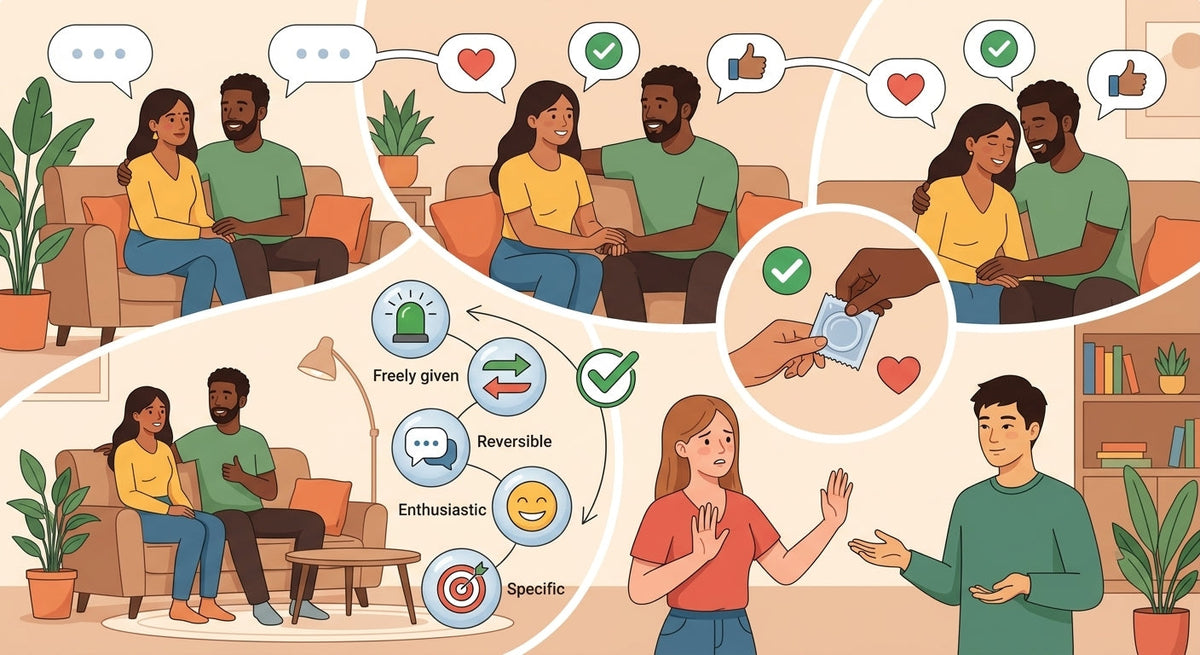
A single "yes" to a kiss does not equal permanent permission for more. Through real-world examples and the FRIES framework, explore why true sexual consent must be freely given, reversible, informe...