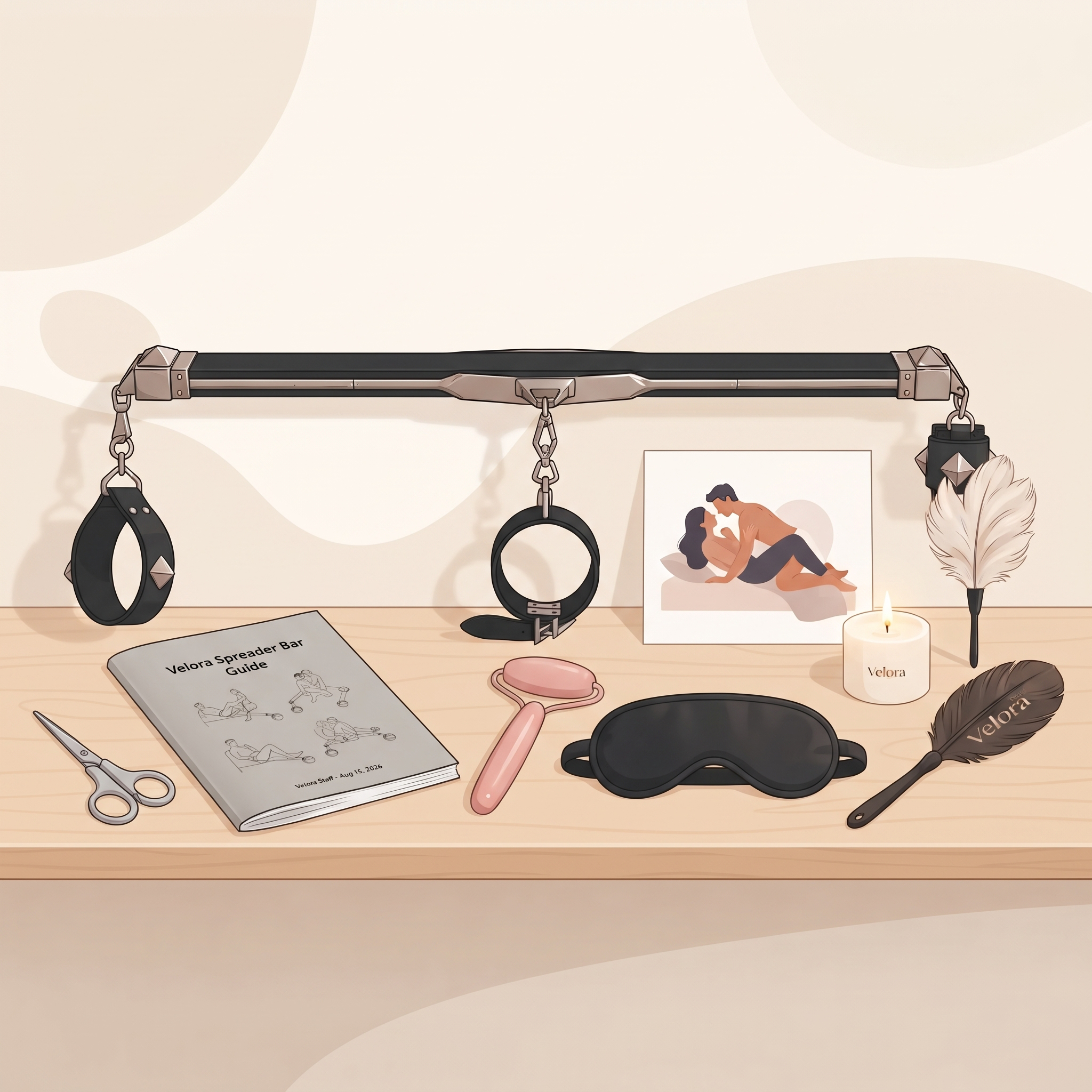
What Is a Spreader Bar? Safety & Couple Roleplay Ideas
Written by Velora Staff on Aug 15, 2026
TL;DR
- A spreader bar holds two restrained body parts at a chosen distance, creating stillness, openness and a temporary transfer of positional control.
- Begin with the shortest comfortable setting, keep the wearer supported with their hands free and make sure the bar can be removed within seconds.
- Width is never the goal. Comfort, natural joint alignment, active communication and mutual enjoyment matter far more.
- Release immediately if you notice numbness, unusual coldness or colour changes, sharp pain, panic, confusion or reduced responsiveness.
A spreader bar may look simple, but the moment it is introduced, the whole mood can shift. Suddenly, there is more stillness, more exposure and that exciting sense of “Okay… what happens next?” To me, it is not just another bondage tool. It can turn positioning, anticipation and a temporary handover of control into part of the fun—which is exactly why comfort, thoughtful design and a release that takes only seconds matter so much.
At Velora, we learned this firsthand while developing our own spreader bar. We did not want to assume that one design—or one position—would work for everybody. After months of testing different lengths, materials and release mechanisms, we came away with a very simple belief: the best spreader-bar experience is not about choosing the widest setting. It is about finding a position that feels exciting, comfortable and right for the two people using it.
What Does a Spreader Bar Do Physically?
A spreader bar keeps two restrained body parts at a chosen distance—most often the legs or ankles. That may sound rather technical, but in a scene, it can create an exciting mix of openness, stillness and “What might happen next?” by preventing the wearer from simply bringing their legs together. It is a positioning aid, though, not a flexibility challenge or an invitation to push anyone’s joints beyond their natural range.

Velora’s Adjustable Spreader Bar offers four length settings to suit different bodies, mobility levels and scenes. At Velora, we think of them as choices—not four levels that everyone should try to “complete.” The widest setting will not feel right for every body, while the shortest can still create plenty of psychological intensity and fun.
When using the bar between the ankles, keep the knees slightly bent and allow the feet to rest naturally. Choose a bed or padded floor so the wearer’s body is fully supported—and never ask someone secured at the ankles to stand or balance.
How Can a Couple Begin at a Lower Intensity?
Assemble, adjust and release it together while no one is wearing it. It may not be the most glamorous part, but knowing exactly how every buckle and connector works can make the real scene feel more relaxed—and much more fun.
For your first try:
- Begin with the shortest setting and choose a comfortable, reclined position on a firm mattress.
- Let the wearer keep both hands completely free.
- Keep the knees soft and the feet naturally aligned. The restraints should feel secure without pinching or digging in.
- Agree that “yellow” means pause and check in, while “red” means release immediately.
- Check in every two to three minutes, even if everything seems fine. Treat ten minutes as the limit, not a challenge to complete.
- Curious about the next setting? Release the wearer first, adjust the bar one step wider and check their alignment again. Never lengthen the bar while it is loaded against the body.
- Keep safety shears and everything needed for a quick release within reach. Never leave a restrained person alone.
If you and your partner are curious about spreader bar play, Velora’s guide to talking about kinks and our Yes/No/Maybe list can help you begin the conversation and discover whether this adventure appeals to both of you.
For this first date with the spreader bar, let it be the star. Save the blindfold, gag, impact toys and extra restraints for another time, once you both understand how the bar feels on its own.
Before planning a longer scene, use Velora’s BDSM Healthy Practice Checklist to review boundaries, health considerations, signals and aftercare together.
Three Couple Roleplay Ideas With the Spreader Bar at the Centre
The Designer and the Voluntary Product Tester

The characters are an exacting designer and a confident product tester whose feedback determines whether the invention passes.
Inspect the spreader bar’s four settings together. The tester chooses one; the designer attaches it, checks the wearer’s alignment and asks about pressure, stillness and trust. After a brief timed pose, the designer must release the bar within seconds before another “test” can begin.
The spreader bar is the experiment, while the tester retains final authority over its setting and duration. Agree beforehand whether technical language feels playful or too clinical, and never widen the bar while it is attached.
The Curator and the Living Sculpture

The characters are a private-gallery curator and a living sculpture commissioned for a one-person exhibition.
Together, choose the spreader-bar setting and supported position that will create the sculpture’s “frame.” Once it is attached, the curator describes how the bar shapes the pose, circles the bed to admire the exhibition and uses Velora’s Feather Teaser Stick like an artist’s brush.
The scene cannot exist without the spreader bar: it creates and maintains the displayed position until the curator opens the frame. Beforehand, agree on acceptable body descriptions, touch areas and whether words such as “displayed” feel exciting or uncomfortable.
The Keyholder and the Consensual Captive

The characters are a trusted keyholder and a willing captive entering a temporary private cell.
The wearer chooses the agreed width, ceremonially hands the spreader bar to the keyholder and lies on the bed. Attaching the bar closes the imaginary cell; removing it opens the door. The keyholder uses the Velora Bell Sound Stick to signal three stages: securing the bar, completing a pre-negotiated task while holding the position, and releasing the wearer.
The captive’s hands remain free and there is no forced struggling. The story may delay the theatrical release, but never the real one: “red,” distress or a warning sign opens the cell immediately.
Warning Signs That Mean Stop Immediately
Release the wearer even without a safeword if you notice:
- Numbness or tingling, burning, loss of sensation or weakness
- Feet or toes becoming unusually cold, pale, blue, purple or swollen—possible signs of reduced circulation
- Sharp, tearing or popping pain in the hips, knees, ankles or lower back
- Panic, hyperventilation, frantic struggling or uncontrolled crying
- Sudden limpness, a frozen expression, confusion, failure to respond, or other signs of dissociation
Colour changes can be harder to see on darker skin, so check temperature, sensation and responsiveness too. Never dismiss reduced responsiveness as “subspace.” Release first. If severe pain, altered colour, numbness or unresponsiveness persists, seek urgent medical help.
Who Should Avoid a Rigid Spreader Bar?
Someone with chronic joint instability, hip dysplasia, previous dislocations, severe arthritis, recent hip or knee surgery, acute lower-back pain, impaired sensation or a circulation disorder should avoid the bar or consult an appropriate healthcare professional first.
A trauma history does not automatically exclude someone. If immobilization may trigger panic, flashbacks or dissociation, speak with a trauma-informed professional before experimenting. Choosing not to use a spreader bar is completely valid.
Aftercare: Help the Body and the Couple Return
When a scene reaches its planned ending, I like to treat the release as part of the experience—not as something to rush through. Gently unfasten the bar without pulling or twisting the wearer’s limbs. Check their skin colour, temperature and sensation, then let them slowly bend their knees and move their ankles. If an area feels numb, never force a stretch or massage it vigorously.
Next comes the soft landing, which may be my favourite part. Bring some water, something warm and perhaps a well-earned snack. Ask, “Would you like a cuddle, reassuring words, quiet company or a little space?” Check in again that evening or the next day about how they are feeling, both physically and emotionally.
To me, a wonderful spreader-bar scene is not about choosing the widest setting or lasting the longest. It is about choosing together, paying attention and knowing either person can stop the fun immediately. At Velora, quick release will always beat extra shine or drama. Safety is part of what makes the play feel good.
Frequently Asked Questions
Is a Spreader Bar Suitable for Beginners?
It can be, but beginner-friendly does not mean risk-free. Start with the shortest comfortable setting, use a fully supported position, keep the wearer’s hands free and practise the quick release before the scene begins. Keep the first experience brief and stop immediately if there is pain, numbness or distress. Being new is not the problem—rushing toward a wider or more complicated position is.
Can spreader-bar play be sensual without being painful?
Absolutely. It does not need to involve pain, impact play or penetration. Eye contact, affectionate words, anticipation and gentle touch can make a simple position feel surprisingly intimate.
Do we need to identify as dominant and submissive?
Not at all. Some couples enjoy clear roles, while others simply treat the bar as a playful positioning tool. You can switch roles, invent characters or skip labels altogether.
What if we start laughing or the scene feels awkward?
Then laugh together. Trying something new does not have to look perfectly serious or cinematic. Pause, adjust or end the scene—and let the awkward moment become part of the memory rather than treating it as a failure.
Does the partner directing the scene need aftercare too?
They might. Responsibility, concentration and power exchange can affect both people emotionally. Afterward, check in with each other and ask what would feel good, whether that is affection, reassurance, conversation or quiet time together.
How should a spreader bar be cared for between scenes?
Follow its specific cleaning instructions, allow every component to dry fully and store it somewhere clean and dry. Before using it again, inspect the cuffs, stitching, connectors and release mechanism for wear or damage.
Sources
-
Dunkley, C. R., and Brotto, L. A. (2020). “The Role of Consent in the Context of BDSM.” Sexual Abuse, 32(6), 657–678.
Website: https://pubmed.ncbi.nlm.nih.gov/31010393/ -
MedlinePlus, U.S. National Library of Medicine. “Numbness and Tingling.”
Website: https://medlineplus.gov/ency/article/003206.htm -
Cleveland Clinic. “Acrocyanosis: Symptoms, Causes and Treatment.”
Website: https://my.clevelandclinic.org/health/diseases/acrocyanosis -
NHS. “Dissociative Disorders.”
Website: https://www.nhs.uk/mental-health/conditions/dissociative-disorders/
Explore Your Kind of Comfort
At Velora Intima, we redefine intimacy through wellness, education, and empowerment. From everyday essentials to adventurous exploration and refined luxury, our thoughtfully designed collections create safe, elegant, and empowering spaces for self-discovery and connection.