

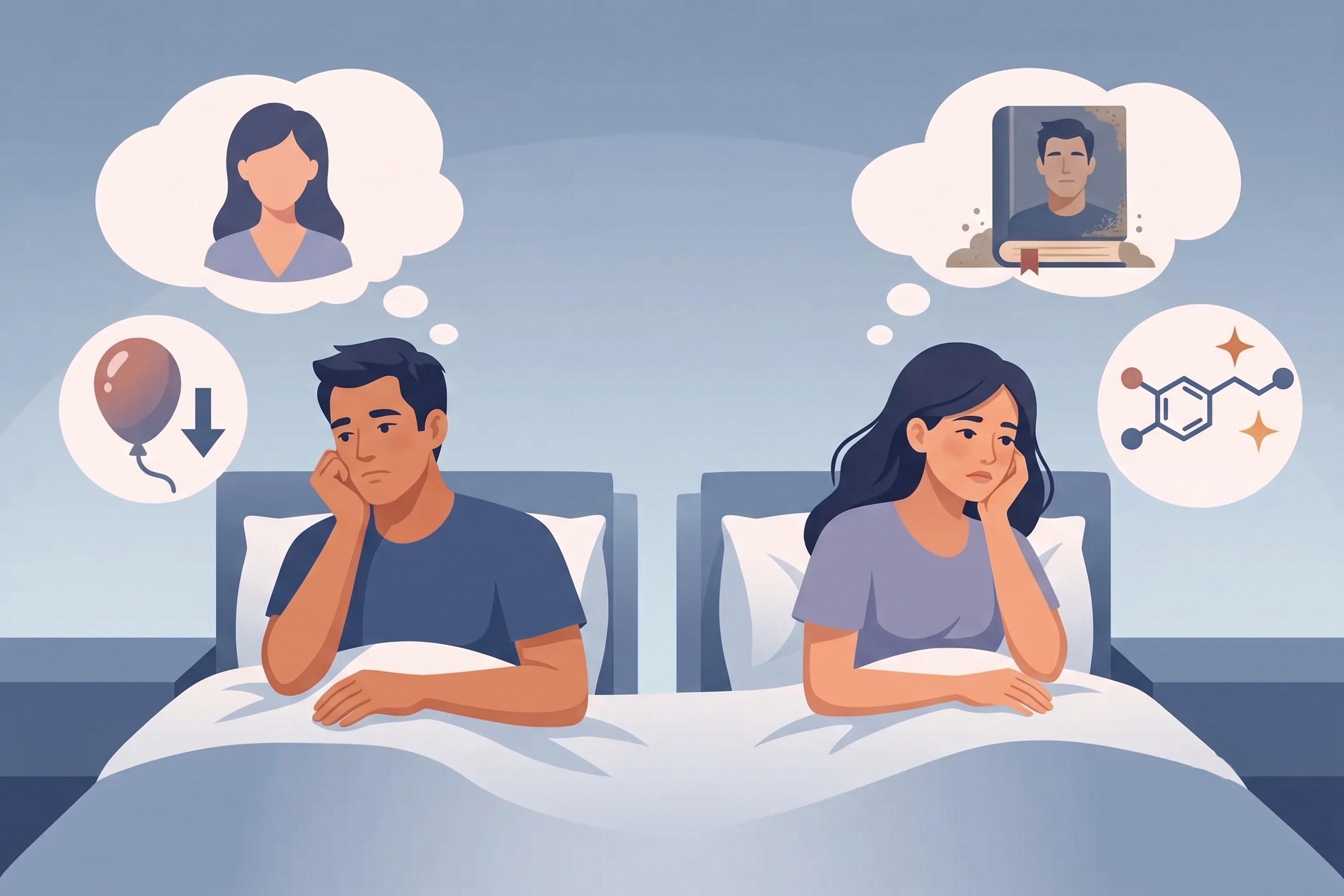
Why Do People Cheat? The Role of Variety and Novelty
Why do people cheat? Some blame biology. Others point to unhappy relationships, opportunity or social media. Through my work at Velora and my reading on infidelity, I have come to believe that cheating is rarely caused by one factor.
Biology, personality, opportunity, relationship quality, culture, technology and life stage can all interact.
An explanation is not an excuse. Infidelity involves violating a relationship’s agreed boundaries without a partner’s knowledge or consent. Excitement may be human, but betrayal is a choice. When a desire for excitement is expressed through deception, it often deeply harms both the betrayed partner and the relationship they believed they were building.
What Counts as Cheating?
Every couple defines boundaries differently, so partners need to discuss what fidelity means rather than assume they agree.
In this article, we are discussing “cheating” which includes both sexual and emotional infidelity.
Why People Cheat
Many affairs begin with small permissions. Most of us have heard variations of these statements: “It is only a message.” “My partner would not understand, so I will not mention it.” With today’s technology, a small boundary crossing can escalate quickly. Desires are human, but infidelity is a choice. There are healthy, consensual ways to spark desire. Before exploring those options, let’s look at what research suggests about infidelity, novelty and desire.
Biology and Novelty
The human brain often responds strongly to novelty. The studies discussed below explore how familiarity, reward and sexual variety may influence desire.
Put simply, novel experiences can create anticipation and excitement. Dopamine plays a role in motivation and reward-seeking, so a new person may feel especially intense partly because they are unfamiliar and unpredictable.
A research1 review on partner novelty found that sexual desire and arousal can decline with familiarity and rise with novelty in both women and men, although the effect may be stronger in men.
Another study2 found that, in experimental scenarios involving potential short-term partners, men showed a greater preference for sexual variety than women. That does not mean women do not seek novelty, or that men are destined to cheat. Infidelity remains a choice.
A study3 of the dopamine D4 receptor gene, or DRD4, examined a genetic variant previously associated with novelty- and sensation-seeking. The researchers studied 181 young adults and found that participants in the 7R+ group were more likely to report having had a one-night stand. Among participants who reported infidelity, those in the 7R+ group also reported more partners outside their committed relationships.
However, the difference between the genetic groups in whether they had ever been unfaithful did not reach statistical significance. The researchers also acknowledged the study’s limitations and several possible alternative explanations. This was a small, exploratory association study—not the discovery of a gene that makes someone betray a partner.
Genes may influence tendencies related to motivation, reward or sensation-seeking. They do not write text messages, arrange hotel rooms or lie to a partner. We are not prisoners of our genes.
How Couples Can Create Novelty Together
Self-expansion research4 suggests that couples may benefit from engaging in new and stimulating activities together. In three experiments, couples who completed a seven-minute novel and arousing task together showed greater immediate increases in experienced relationship quality than those who completed a more mundane task.
Novelty might mean trying a new restaurant, watching a scary movie, exploring a new sexual position or introducing a sex toy together. When couples experience something exciting as a team, they may begin to associate the relationship with curiosity and discovery again. Sometimes, you do not need to change the “who”; you can refresh the “what” with the person you love.
A Velora Customer’s Story
One of Velora’s repeat customers bought her first toy after discovering that her boyfriend had cheated. She was not ready for another relationship, but she missed pleasure and wanted a private way to experience sexual relief. That was when she purchased her first Velora toy.
Later, she met someone new. About a year into their relationship, sex had become comfortable—but also familiar. One day, she suggested using a toy she already enjoyed. They decided to try it together that evening.
Suddenly, their bedroom felt exciting again. The toy led to new positions and plenty of playful experimentation. The excitement carried into the next day. She still has their playful text messages urging each other to hurry home and try something new from the second day.
I love this story dearly because the same toy first helped her reclaim pleasure after betrayal and later helped her create fresh excitement within a loving relationship.
Practical Ways to Refresh Intimacy
If you are in a loving relationship and worry that familiarity is dimming the spark in the bedroom, consider these practical ideas.
Do a Turnoff Audit
Couples often try to address low desire by adding something new. Sometimes, it is just as important to remove what is blocking arousal.
Ask what makes each of you feel rushed, criticized, exhausted or disconnected. Are phones, stress or unresolved conflict entering the bedroom? Does sex always follow the same script?
Each partner can identify two turnoffs and two turn-ons.
Be specific. Saying “Be more romantic” is difficult to act on. “I feel more open to intimacy when we put our phones away and spend time kissing first” gives your partner something concrete to understand.
Schedule Intimacy, Not Sex
Scheduling sex can create pressure for some couples. Another option is to schedule time for physical intimacy without deciding what must happen. You might cuddle, massage each other, kiss or use a toy.
Many people experience responsive desire5: desire may emerge after they feel safe, relaxed and physically engaged rather than appearing spontaneously at the beginning.
The goal is not to force an orgasm. It is to create a context in which desire can emerge.
How to Introduce a Sex Toy
The best time to discuss bringing a sex toy into your relationship is when neither of you is naked.
Choose a calm moment. You might say, “I love what we already do, and I think it could be exciting to try something new together.” Make the conversation about adding pleasure, not fixing a failure.
A Yes/No/Maybe list can help couples compare interests without pressure. Each partner marks possible activities as:
- Yes: I would enjoy trying this.
- Maybe: I am open to discussing it.
- No: I do not want this.
Start with shared yeses, discuss the maybes and respect the 'No's.
Choose the first toy together. For beginners, I recommend something that does not feel visually intimidating.
In the customer story above, the Velora Heart vibrator worked well for her. She described it this way: “The shape of the Velora Heart communicates affection and playfulness. It is soft, powerful and interesting without feeling explicit.” That balance is exactly what we hoped to create: a toy that feels playful and sensual while still reflecting love.
During your first experience using a toy together, focus on pleasure rather than orgasm. Stay relaxed, laugh if something feels awkward and let a hesitant partner control the toy.
Afterward, talk about what felt best and what you might change next time. Keep the conversation curious rather than turning it into a performance review.
My Honest Opinion
New conversations, adventures and ways of touching may help a relationship feel alive, yet no amount of creativity can make another person choose honesty. A partner’s betrayal is never the betrayed person’s fault.
One meaningful form of protection is a relationship in which both people can speak honestly about boredom, attraction, desire, and unmet needs. Human beings are capable of both pair-bonding and novelty-seeking. In my view, desire can become an invitation to explore something new with the person you love. In a healthy relationship, that is the best form of novelty.
Sources
- Morton, H., & Gorzalka, B. B. (2015). Role of partner novelty in sexual functioning: A review. Journal of Sex & Marital Therapy, 41(6), 593–609. https://doi.org/10.1080/0092623X.2014.958788
- Hughes, S. M., Aung, T., Harrison, M. A., LaFayette, J. N., & Gallup, G. G. (2021). Experimental evidence for sex differences in sexual variety preferences: Support for the Coolidge effect in humans. Archives of Sexual Behavior, 50, 495–509. https://doi.org/10.1007/s10508-020-01730-x
- Garcia, J. R., MacKillop, J., Aller, E. L., Merriwether, A. M., Wilson, D. S., & Lum, J. K. (2010). Associations between dopamine D4 receptor gene variation with both infidelity and sexual promiscuity. PLOS ONE, 5(11), e14162. https://doi.org/10.1371/journal.pone.0014162
- Aron, A., Norman, C. C., Aron, E. N., McKenna, C., & Heyman, R. E. (2000). Couples’ shared participation in novel and arousing activities and experienced relationship quality. Journal of Personality and Social Psychology, 78(2), 273–284. https://pubmed.ncbi.nlm.nih.gov/10707334/
- Basson, R. (2000). The female sexual response: A different model. Journal of Sex & Marital Therapy, 26(1), 51–65. https://doi.org/10.1080/009262300278641
At Velora Intima, we redefine intimacy through wellness, education, and empowerment. From everyday essentials to adventurous exploration and refined luxury, our thoughtfully designed collections create safe, elegant, and empowering spaces for self-discovery and connection.


Read more

This warm and empowering beginner’s guide explores the importance of clitoral masturbation, emphasizing that the clitoris is a powerful pleasure organ containing over 10,000 nerve fibers. Highlight...

Discover what healthy BDSM actually entails beyond mainstream media stereotypes. Learn about the importance of consent, respect, and communication for beginners.